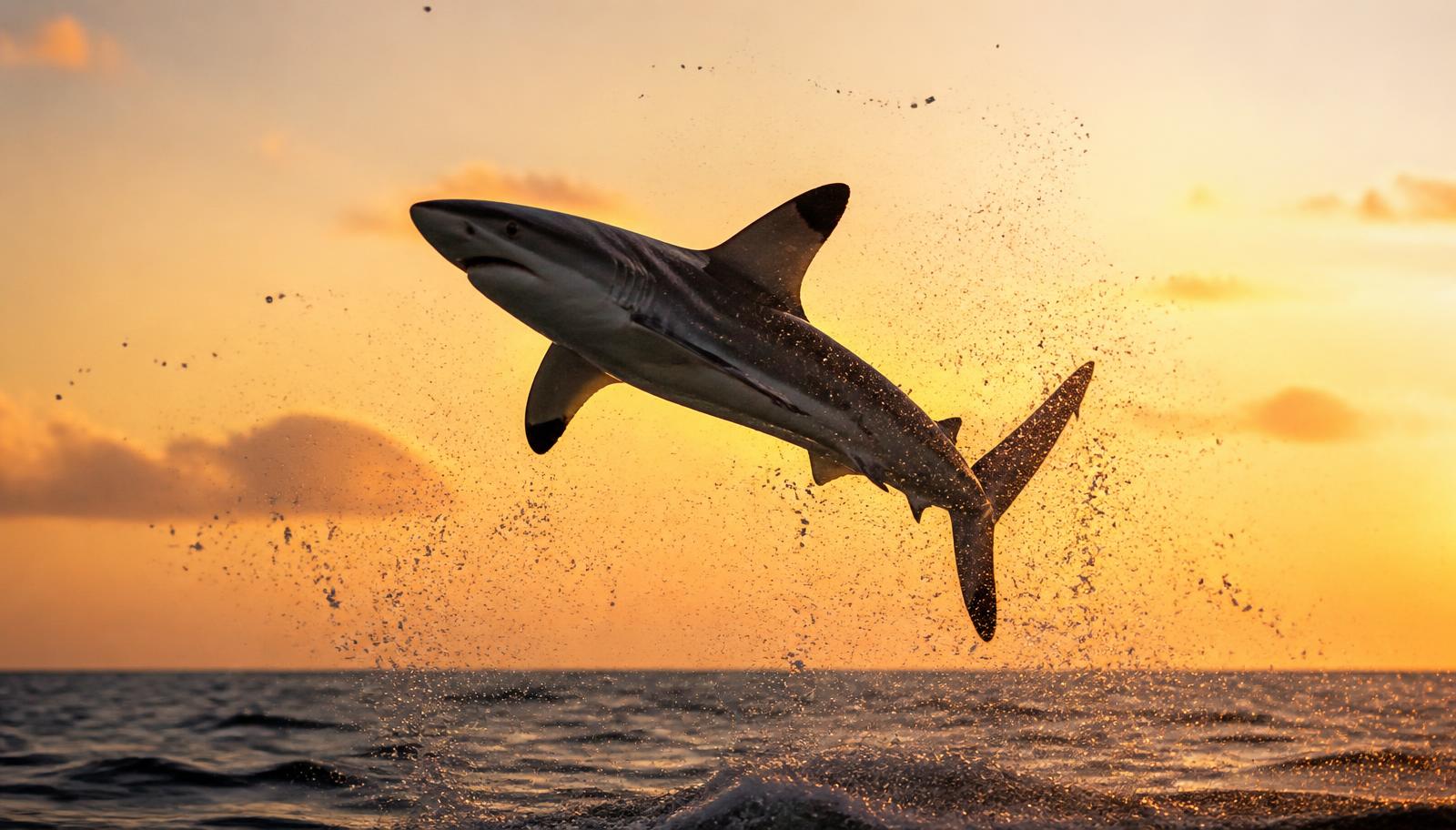
Species profile
The blacktip shark, honestly described.
A mid-sized, fast-moving requiem shark built for chasing schooling fish in shallow coastal water — and one of the most consistently misidentified animals on the Florida coast.
Appearance
Blacktips are streamlined and torpedo-shaped, dark bluish-grey to bronze above with a clean white underside and a pale band running along the flank. The name comes from the black markings on the tips of the pectoral fins, second dorsal, and the lower lobe of the tail. Critically for identification, the anal fin is not black-tipped — that single detail separates them from spinner sharks more reliably than anything else.
Diet and hunting
Blacktips are specialists in schooling fish: mullet, menhaden, sardines, herring, jacks, and whatever else stacks up against a sandbar. They hunt by driving into bait balls at high speed, often from below, and their strike is committed and fast. That hunting style is exactly why murky, bait-filled surf is the highest-risk setting for an accidental bite — the shark has milliseconds to decide, and a pale foot kicking through stained water reads a lot like a fish.
Behavior
They are skittish animals. Blacktips typically flee from divers and swimmers and are easily displaced by noise and movement. They aggregate in large loose schools during migration, sometimes numbering in the tens of thousands off Florida's southeast coast in winter. Blacktips are also one of the few shark species with confirmed parthenogenesis — recorded reproduction without a male.
Reproduction
Females are viviparous, carrying 4–7 pups for 10 to 12 months and typically giving birth every other year in shallow coastal nurseries. Estuaries and protected inshore waters along Florida and the Gulf serve as pupping grounds, which is part of why juvenile blacktips are common close to shore.
Conservation
Globally the species is assessed as Vulnerable, pressured by commercial and recreational fisheries and by bycatch. The US Atlantic stock is comparatively well managed under federal shark management plans, but slow reproduction makes recovery from overfishing a decades-long process for any population.
Identification
Blacktip vs spinner shark
In New Smyrna Beach these two species share the same water, the same bait, and most of the same bite statistics. Even experienced watermen mix them up — here is how to actually tell them apart.
| Trait | Blacktip (C. limbatus) | Spinner (C. brevipinna) |
|---|---|---|
| First dorsal fin | Starts above or slightly behind the pectoral fin insertion; tall and pointed | Starts noticeably further back, behind the pectoral fins |
| Anal fin tip | Usually pale or white — not black | Distinctly black-tipped |
| Snout | Shorter, more pointed | Longer and more slender |
| Spinning leaps | Occasional, less rotation | Signature corkscrew spin clear of the water |
| Teeth | Narrow, serrated along the full edge | Narrow, serrations mostly near the tip |
Photography note: replace with real comparative fin-detail photography when available.
Both species drive the local picture at New Smyrna Beach and both follow the same seasonal migration.
Ask about Blacktips
Research assistant with live sources
Ask about biology, migration, behavior, conservation or New Smyrna Beach conditions. Answers are generated from current sources and returned with citations.